
Escape Rooms for 2 People: Is It Actually Better Than a Big Group?
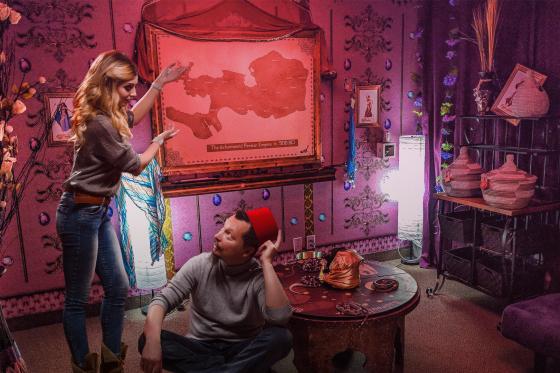
A lot of people assume an escape room only works with a loud crew of six. Two players can actually be more fun. You don't hide behind anyone, every puzzle is yours, and in an hour you learn more about your partner than over three dinners at a restaurant. There's a catch, though. Not every room can be pulled off by two people, and that comes down to difficulty, the number of tasks, and your experience.
Let's work out when playing as a pair is a blast, and when you're better off calling in a few more people.
Can You Do an Escape Room With Two People?
Yes, you can. It depends on the room, though. Each one has its own minimum and recommended group size, and those numbers aren't pulled out of thin air. If a room was designed for a team of four to six, it physically has more mechanisms, parallel branches, and tasks that need doing at the same time. Two people might simply not manage to cover every point within the hour.
Experience isn't a must here. A pair of first-timers gets through a beginner-level room just fine, as long as they judged the difficulty honestly before booking. A lot rides on the Game Master. A good host can tell when two players are stuck not because they're clueless, but because the task was built for more hands, and drops a hint a little earlier than they would for a team of six.
So there's one golden rule: check the specific room's rules before booking. Not every scenario is built for two, and a decent venue will tell you outright the minimum number of players a room needs to work properly.

Two Players vs a Bigger Team: What Actually Changes?
The question isn't which is objectively better. The experience is just different, and it's worth knowing which one you're signing up for.
When there are two of you:
- More puzzles land on each person, which means there's never a dull moment.
- Hiding behind the more active players won't work, because the active players are both of you.
- You have to keep saying out loud what you're seeing and what you're doing.
- Every decision you make actually moves the game forward, with no option of letting someone else figure it out.
- The atmosphere presses harder, and in a horror room that hits especially close.
A big team works differently:
- Five people can rummage through different corners at once and find clues faster.
- Tasks are easy to split up: one works the locks, another assembles a code, another reads through the notes.
- More heads, more theories, and the right one turns up among them more often.
- The social side: shared laughter, jokes, the team feeling of a win.
- There's a downside too. Six people in a small room sometimes get in each other's way and take longer to sort out who's doing what.
A simple rule of thumb. Want intensity and full immersion, take a two-player scenario, something like Five Lives. Want a light, high-energy night with a crowd and less pressure on each person, bring the whole group and pick an adventure built for more players, like Senator's Battle, which can be played with up to 16 people.
Why a 2-Person Escape Room Can Be Great for a Date
A date in an escape room knocks you out of that awkward setup where you sit across from each other scrambling for a new topic. Here there's a shared goal and a timer that won't let you get stuck in a silence. You search for things together, get it wrong, laugh at the dead-end theories.
An hour of play shows you what no dating-app profile ever will. How a person thinks under pressure. Whether they get angry when things don't work. Whether they listen to your ideas or push their own line. Whether they can admit you were right once the lock finally opens on your code.
And a separate bonus: after the game you're guaranteed to have something to talk about. Not a forced conversation about work and the weather, but real emotion from what you just went through. It doesn't turn every room into a romance setting, but as an idea for an unconventional date it works without fail.

How to Choose an Escape Room for Two People in Edmonton
Before you hit "book," run through a few parameters. It takes three minutes and saves you from a ruined evening.
- Minimum and recommended number of players: whether the room works for two at all.
- Difficulty: for your first time as a pair, go with a lower level.
- Duration: how long the game runs, so you can pace yourselves.
- Theme: detective, adventure, mystery, or something lighter.
- The experience level the scenario is built for.
- Whether you're both comfortable with horror and scary themes, since scary feels stronger with just two of you.
- Availability for the date and time you want.
Once those line up, all that's left is picking the room. Browse the available scenarios at Escape Hour in Edmonton, check a specific room's conditions against what suits your duo, and book the one where the two of you will feel confident. Beginner and mid-level rooms usually land best with pairs, and if the first game hooks you, next time you'll take something harder.
FAQ
Can two people do an escape room?
Yes, if that particular room allows a team of two. Check the minimum group size in the scenario description before booking. Some rooms are built specifically for small groups, while others need more hands, and two players will struggle to beat the timer there.
Are escape rooms harder with only two people?
They can be harder. Fewer people means fewer hands searching for clues and working the mechanisms at once, so more falls on each of you. But that's exactly what a lot of people love about playing as a pair: you're not a spectator, you're a full participant on whom the result depends.
Are escape rooms good for couples?
Yes, and especially as an interactive date night. If you both enjoy puzzles, challenges, and shared activities, it's one of the best formats for spending an evening together. You're not just sitting side by side, you're working toward one goal together, and that brings you closer faster than a standard dinner.
Is a 2-person escape room better than playing with a group?
There's no objectively better option. As a pair, the experience is more intense, and each person is fully involved. A big team gives you more resources to split tasks in parallel and move faster. The choice comes down to what you want from the evening: deep immersion or a light group scramble.