
Languages of love in escape rooms: how couples communicate under pressure
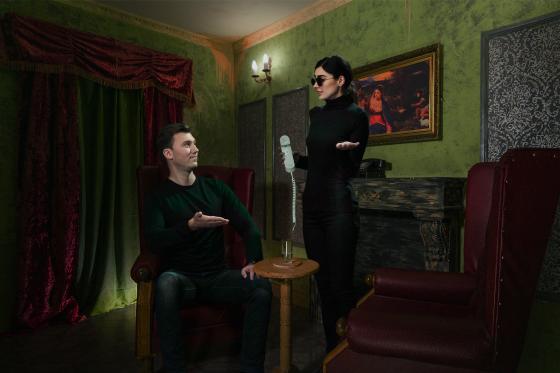
Languages of love are usually discussed in a relaxed setting. When there is time, the tea is hot, and the mood is calm. But let's be honest: real communication happens not when everything is fine, but when there is a little pressure. When something doesn't work out. When the clock is ticking. That's why an escape room is an unexpectedly honest place to see how you really show your love.
There's no room for pretty words here. Automatic reactions come into play. And they say a lot.
Time pressure as a litmus test for relationships
There are no pauses in the quest. You can't take a break to think everything through in detail. There is a puzzle, a team, and a deadline. Under such pressure, roles, masks, and social scenarios disappear. What remains is pure interaction: how you speak, how you listen, how you react to each other's mistakes.
And suddenly it becomes clear:
- someone supports with words
- someone silently takes on a difficult task
- someone jokes to relieve tension
- and someone constantly monitors their partner's every step, not to undermine them, but only to support them in the most difficult moments.
These are the languages of love. When words are not needed. Actions, movements, and glances speak for you.

Words of support: “We can do it.”
In some couples, love is loud. “Good idea,” “Let's try again,” “Relax, we're on time.”
In a quest, such phrases are especially valuable. They are not for romance — they are for stability. When something doesn't work out, words of support can bring the team back together.
This is the moment when a partner does not criticize, but encourages. Does not pressure, but adds confidence.
Actions instead of words: “I'll figure it out.”
Another language of love is action. Someone silently takes on a complex mechanism. Someone returns to the puzzle a third time because they see that their partner is already tired. No comments. No unnecessary words or emotions. They just take over and help, they do it.
In a quest, such gestures are immediately visible. And they often say more than any words.
Time and attention: “We're doing this together”
There are couples who stay close throughout the entire quest. They discuss every little detail, constantly check with each other, and don't run around the room. It is important for them to be together in the process, even if it is not the most effective from a game perspective.
This is the language of love about shared time and involvement. About the feeling that they are in the same story, not just in the same room. This is what unites two hearts.
Touch and nonverbal support
A slight gesture, a glance, a smile after a failure. In a quest, this works surprisingly well.
When words are superfluous and there is no time, such little things become a signal: “I'm with you, everything is okay.”
And it is under pressure that these signals either appear naturally or... do not appear at all. And this is also honest information.
Mistakes as a test of care
Everyone makes mistakes in a quest. That's not the point. What matters is how you react to each other's mistakes.
- With humor or reproach?
- With support or irritation?
- With a desire to help or to prove that “I told you so”?
These moments are very revealing. Because they are almost identical to those that occur in real life. Only here, everything is condensed into one hour.
These are the languages of love that manifest themselves in our quest rooms. It doesn't matter whether you choose a horror scenario or a detective investigation. What matters is what you say, how you act together, and how you complement each other. Because at that moment, you are one.

Why a quest room is more honest than a conversation about relationships
Conversations are important. But it's easy to embellish reality in them. A quest doesn't allow that. It doesn't ask how you see your relationship. It shows how you act in it.
No drama or conclusions. And if there are emotions, they are sincere; it's hard to fake joy, fear, or confusion in an escape room. This is where sincere feelings and true emotions are revealed. You gain an experience that makes many things in your relationship clearer.
EscapeHour as a safe space for such an experience
In EscapeHour quest rooms, the atmosphere is designed so that couples feel excitement rather than pressure. The scenarios are logical, the pace is controlled, and the Game Master is always nearby if you need a hint or a pause.
This is not a test of strength. It is an opportunity to see each other in action, without fear and without judgment.
The languages of love are manifested in small things. Especially when there is no time to think about what is right. The quest room simply creates conditions where these small things become visible.
Sometimes after such a date, you don't want to talk about how romantic it was. You want to say, “I felt safe with you.” And that, you must agree, is much deeper. Maybe it's time to go on a quest thanks to the language of love?
FAQ
Is this game suitable for couples who don't like stress?
Yes. At EscapeHour, stress is manageable. It's more about excitement and concentration than tension. Plus, you can always take a hint and slow down the pace.
What if we argue during the quest?
Minor disagreements are normal. Often after the game, couples laugh about these moments and understand each other's reactions better. It's a safe format where mistakes don't have serious consequences.
Can we go on a quest if we've just started dating?
Yes, you can, and it's even useful. The quest quickly shows how you work together, without long explanations and awkward pauses.