
Not Just for Nerds: Debunking the Geeky Stereotype of Escape Rooms
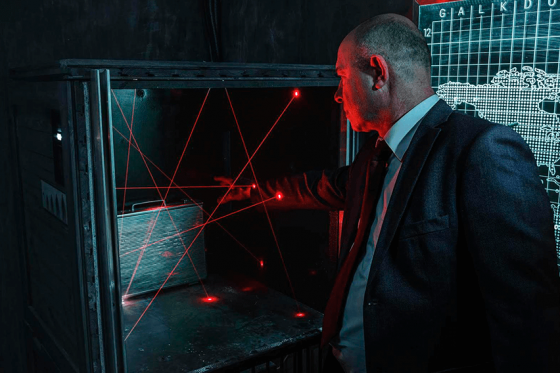
When you hear "escape room," what does your imagination picture? Probably a group of guys in superhero T-shirts who spend an hour and a half solving complex equations, quoting "Star Wars," and cracking codes in C++? This stereotype is as old as the myth that video games are only for kids. Reality looks completely different. A modern escape room is not a math olympiad in a dark basement. It is a Hollywood blockbuster where you accidentally got the leading role. No one asks for your university diploma, no one demands that you know the periodic table, and they definitely do not make you calculate integrals. It is entertainment for office managers, young moms, tough bikers, and couples in love. So why has the label "entertainment for geeks" become hopelessly outdated, and what actually happens behind closed doors?
Intuition vs. Encyclopedia: Forget About IQ
The biggest mistake beginners make is thinking that you have to be "very smart" in an escape room. People are afraid of looking stupid in front of friends if they cannot solve a puzzle. But the industry secret is that 99% of tasks are designed for ordinary human logic, attention to detail, and the ability to connect A to B. Room designers deliberately avoid tasks that require specific knowledge (for example, the history of France or Morse code), because that is boring. Instead of erudition, you need "street smarts" and a willingness to experiment. Often, it is people with a scientific degree who slow the game down, trying to find a complex solution where you just need to pull a lever.

Your Superpower Is Not Your Brain, but Your Team
An escape room is прежде all a social experiment and a communication workout. You are not taking an exam alone. Success depends not on how fast you think, but on how loudly you speak and whether you can hear others.
Here is why there is a place on the team for everyone, even if you hate puzzles:
- "The Finder." While the “smart ones” think about a cipher, this person simply turns the room upside down and finds the key under the doormat. It is the most important role, because without found objects no logic will work.
- "The Communicator." The person who simply voices everything they see. "Oh, there’s a red button here!", "And here’s a red light!". Thanks to such players, the team connects the facts together.
- "The Doer." The one who is not afraid to stick a hand into a dark hole, press levers, or assemble a mechanism. While others theorize, they just try—and it often works.
So if you think you will stand in a corner and be bored while others "strain their brains," you are mistaken. The dynamics of the game pull everyone in, and often it is the unconventional perspective of a "humanities person" that saves a team of techies from defeat.
Emotions Instead of Formulas: It’s Just an Adventure
Modern escape rooms have evolved. Now it is not just a set of locks and keys. It is "Indiana Jones," "Sherlock Holmes," and "Saw" in one bottle. People go there not to prove their genius, but to get a dose of adrenaline that a trip to the cinema or a bar will not provide. The setting, sound effects, decorations—all of it works for the atmosphere. You can feel like a bank robber, a prisoner of Alcatraz, or a ghost hunter. In such an environment, you forget who you are professionally. You just run, search, laugh, and get scared. It is emotional relief that "reboots" your brain better than any personal growth training.
Why Is This Better Than an Evening at a Pub?
The "nerd" stereotype appeared at the dawn of the industry, when escape rooms really were schematic and dry. Now it is a mainstream form of leisure that competes with bowling and karaoke.
It is an ideal option for those who are tired of banal routines:
- Live communication. You cannot sit on your phone here. You are forced to interact with friends in real time, which brings you incredibly close.
- Variety of genres. Don’t like puzzles? Choose an action game where you need to move and hide. Don’t like horror? Go to a fun adventure quest.
- Fast results. In 60 minutes you live a small life with a clear ending. Victory gives you euphoria you want to feel again and again.
So drop the prejudice. An escape room is not an IQ test; it is a test of your ability to have fun and be part of a team.

If you have been avoiding escape rooms because you are afraid of seeming "not smart enough" or think it is entertainment for programmers—you are stealing emotions from yourself. It is a universal type of entertainment where the main requirement is a sense of humor and comfortable shoes. Don’t be afraid to try something new at Escapehour, because, in the end, the worst thing that can happen is that you won’t get out of the room on time—but you will definitely come out with a bunch of stories to discuss over dinner.
FAQ
Do I need knowledge of mathematics or foreign languages?
Absolutely not. All puzzles are based on logic, associations, and attention. If numbers appear anywhere, the most you will have to do is add 2+2, and even for that you will often be given a calculator. The game language is always adapted to the local region.
Are escape rooms suitable for children or older people?
Yes! Children often play better than adults because they do not have шаблонное thinking, and they notice details that adults ignore. For the older generation it is a great mental warm-up; the main thing is to choose an escape room without physical exertion and loud jump scares.
What happens if we can’t solve a puzzle?
You will not be left there to live. You have a direct connection with the game operator. If you reach a dead end, you can ask for a hint. The administrator will suggest which direction to think without ruining the enjoyment of the game. Most teams take hints, and that is absolutely normal.